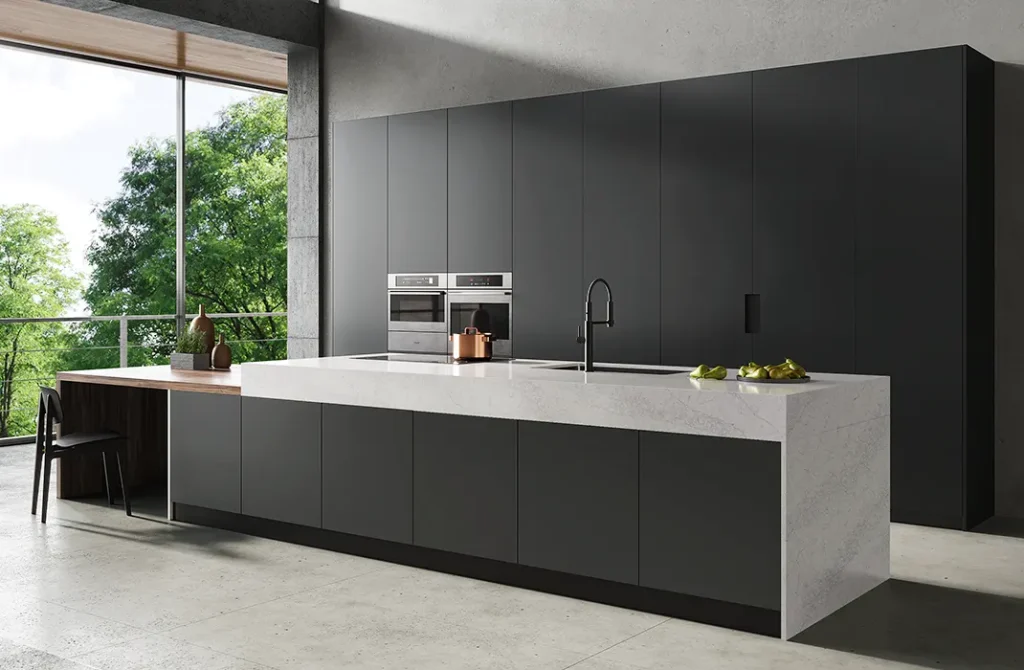
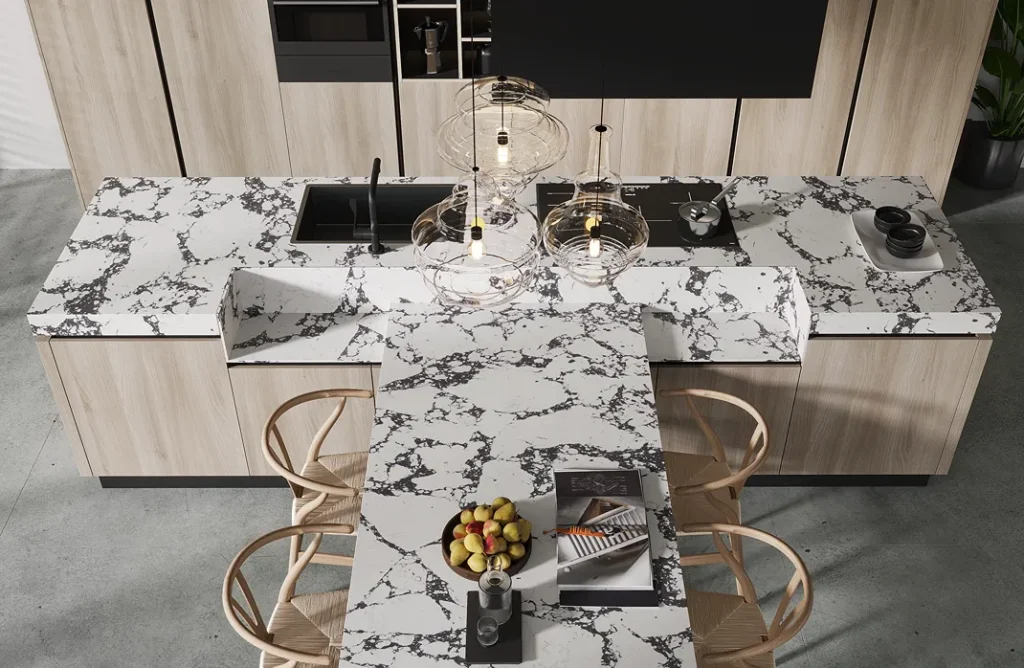
The art of pairing quartz countertops with cabinet colors transforms ordinary kitchens and bathrooms into extraordinary spaces. As an interior designer who has guided countless homeowners through this crucial decision, I’ve witnessed both stunning successes and unfortunate mismatches. This guide delves into the principles, combinations, and insider tips that will help you create harmonious, eye-catching spaces using quartz countertops and complementary cabinet colors.
Color theory serves as the foundation for successful design pairings. When selecting quartz countertops colors, consider the undertones in your cabinet finish. The relationship between these elements creates either visual tension or harmony, depending on your choices.
The extensive quartz countertop color options available today range from pure whites to dramatic blacks and everything in between. These options fall into three main categories: complementary (colors opposite on the color wheel), analogous (colors adjacent on the color wheel), and monochromatic (variations of the same color). Each approach creates a distinctly different feeling in your space.
Have you ever walked into a that immediately felt “right” without knowing exactly why? That sensation often stems from thoughtful color harmony between countertops and cabinets.
In my experience working with high-end residential projects, clients who understand basic color relationships make more confident decisions and experience greater long-term satisfaction with their choices. The subtle variations in white quartz countertops can dramatically affect how they pair with cabinet colors, sometimes in surprising ways.
Popular Quartz Countertops Colors and Their Cabinet Pairings
White Quartz Countertops: Versatile Foundation
White quartz countertops remain the most versatile option for pairing with various cabinet colors. Their popularity stems from their ability to work with virtually any cabinet color while creating a clean, bright aesthetic. The classic combination of quartz countertops with white cabinets creates a timeless look that never goes out of style.
When selecting quartz countertops with white cabinets, consider whether you want a high-contrast or monochromatic look. For monochromatic designs, choose white quartz with similar undertones to your cabinet color. For contrast, select white quartz with veining or patterns that incorporate accent colors from elsewhere in your space.
Case studies show that homes with white quartz and white cabinet combinations sell faster and often at higher price points than those with more specific color choices. This combination provides a neutral canvas that appeals to the broadest range of potential buyers.
Dramatic Dark Quartz: Bold Statement Pieces
Dark quartz countertops (charcoal, black, deep blue) create dramatic focal points when paired with the right cabinets. Understanding cabinet colors that go well with quartz countertops is essential for creating a cohesive kitchen design, especially when working with these bolder options.
Light cabinets (white, cream, light gray) create high-contrast pairings with dark quartz, making both elements stand out. Medium-toned wood cabinets (cherry, maple, oak) create a rich, warm environment when paired with dark quartz. Dark cabinets with dark quartz create a luxurious, enveloping feeling but require careful lighting to prevent the space from feeling too closed in.
Would you believe that the same black quartz countertop can look completely different when paired with white versus cherry cabinets? The surrounding colors dramatically influence our perception of the countertop’s depth and intensity.
Neutral Quartz: The Chameleon Choice
Beige, taupe, and gray quartz offer exceptional versatility. When exploring quartz countertop color options, bring cabinet samples to the showroom for side-by-side comparison. These neutral options adapt to their surroundings, taking on different characteristics depending on the cabinet colors they accompany.
Navy blue and sage green are trending cabinet colors that go well with quartz countertops in neutral tones. The variety of quartz countertops colors available today makes it possible to find the perfect match for any cabinet style, but neutrals offer particular flexibility for future design changes.
In my experience, clients who choose neutral quartz often report the highest satisfaction five years later, as these choices accommodate evolving design preferences without requiring complete renovations.
Real-World Examples: Successful Combinations
The Modern Farmhouse Transformation
According to a case study published by Houzz in their 2023 Kitchen Trends Report, one of the most successful combinations involves white shaker cabinets paired with Calacatta-style quartz countertops. The report analyzed over 2,000 kitchen renovations and found that this combination was rated highest for “timeless appeal” by both homeowners and designers [https://www.houzz.com/magazine/2023-u-s-houzz-kitchen-trends-study-stsetivw-vs~160657651].
One homeowner in Portland, Oregon, transformed their dated 1990s kitchen using Benjamin Moore “Simply White” cabinets paired with MSI’s Calacatta Verona quartz. The quartz featured subtle gray veining that tied in with stainless steel appliances and a pale gray backsplash. Three years after installation, the homeowner reported that the combination “still feels fresh and current,” despite changing design trends.
The subtle contrast between the pure white cabinets and the slightly warmer white quartz with veining created depth without sacrificing the bright, open feeling the homeowners desired. This real-world application demonstrates how even subtle variations within white tones can create visual interest.
The Bold Contemporary Statement
According to Caesarstone’s 2023 Design Trends Report, dark-colored kitchens saw a 45% increase in popularity among urban homeowners under 40 [https://www.caesarstone.com/en-us/blog/2023-kitchen-trends/]. One standout example featured in their report showcased a San Francisco loft with matte black cabinets paired with Caesarstone’s White Attica quartz.
The dramatic contrast created a sophisticated, contemporary space that photographed beautifully and became one of the most-shared kitchen designs on social media platforms in 2023. The white quartz countertop with black veining created a bridge between the black cabinets and white walls, unifying the space.
Designers often recommend white quartz countertops for smaller kitchens to create an illusion of space. This principle was perfectly demonstrated in this compact loft kitchen, where the white countertops prevented the dark cabinets from making the space feel confined.
Current Trends in Quartz and Cabinet Pairings (2024-2025)
Two-Tone Cabinet Trends
Modern kitchens often feature neutral quartz countertops colors paired with bold cabinet choices. The two-tone cabinet trend continues to gain momentum, with upper and lower cabinets in different colors. This approach typically features darker colors below (navy, forest green, charcoal) and lighter colors above (white, cream, light gray).
When working with two-tone cabinets, quartz countertops serve as the unifying element. Homeowners often choose veined quartz countertops with white cabinets to add visual interest to the kitchen, especially when the upper cabinets are white and the lowers are a contrasting color.
Have you considered how the countertop can serve as the “bridge” between different cabinet colors? This approach allows for more design flexibility while maintaining cohesion.
Warm Minimalism
The stark, cold minimalism of previous years has evolved into “warm minimalism,” featuring natural materials and earthy tones. Modern quartz countertop color options include realistic marble looks without the maintenance concerns, often paired with warm wood cabinets in honey, walnut, or oak tones.
This trend embraces simplicity without sacrificing warmth and character. When selecting quartz countertops colors, consider the undertones in your cabinet finish to ensure they complement rather than clash with these warmer wood tones.
In my experience, clients increasingly request these warm, natural combinations as a reaction to the cool gray trends that dominated the 2010s. The pendulum has swung toward creating spaces that feel both contemporary and comforting.
Designer Tips for Successful Matching
Consider Your Space Holistically
The most successful quartz and cabinet combinations consider the entire space, not just these two elements in isolation. Designers recommend testing cabinet colors that go well with quartz countertops under different lighting conditions. Natural light, overhead lighting, and under-cabinet lighting all affect how colors appear.
When exploring quartz countertop color options, bring cabinet samples to the showroom for side-by-side comparison. Better yet, request larger samples to view in your actual space under various lighting conditions throughout the day.
Case studies show that colors can appear dramatically different between showroom lighting and residential settings. What looks like a perfect match in the store might reveal unexpected undertones in your home.
Balance Statement Pieces
If your quartz countertop features dramatic veining or bold colors, consider more subdued cabinet choices. Conversely, if you’ve fallen in love with statement cabinets in a bold color, a more subtle quartz countertop will create balance.
The relationship between quartz countertops with white cabinets differs significantly from that of quartz with bold-colored cabinets. White cabinets allow the countertop to be the star, while colored cabinets compete for attention.
Have you thought about which element you want as the focal point in your space? This decision should guide your selection process.
Consider Long-Term Appeal
While trends provide inspiration, consider the long-term appeal of your choices. Understanding cabinet colors that go well with quartz countertops is essential for creating a cohesive kitchen design that will stand the test of time.
In my experience, clients who choose highly specific or trendy color combinations often request updates within 5-7 years, while those who select more classic pairings typically enjoy their spaces for 15+ years before desiring changes.
Practical Application: Making Your Selection
The Sample Process
The selection process should always include viewing actual samples in your space. The variety of quartz countertops colors available today makes it possible to find the perfect match for any cabinet style, but samples are essential for accurate evaluation.
Request samples of your top 2-3 quartz options and place them against your cabinet choice (or sample). View these combinations:
In natural daylight
Under your kitchen’s artificial lighting
At different times of day
From different angles and distances
This thorough evaluation prevents expensive disappointments after installation.
Visualization Tools
Many manufacturers now offer visualization tools that allow you to upload photos of your space and digitally “try on” different combinations. While these tools provide helpful starting points, they should supplement rather than replace physical samples.
The subtle variations in white quartz countertops can dramatically affect how they pair with cabinet colors, and these nuances aren’t always accurately represented in digital tools.
Conclusion: Creating Your Perfect Pairing
The perfect match between quartz countertops and cabinet colors creates a foundation for your entire space. By understanding color relationships, considering current trends while respecting timeless principles, and thoroughly testing combinations in your actual space, you’ll create a kitchen or bathroom that brings you joy for years to come.
Remember that while design principles provide valuable guidance, your personal preferences matter most. The classic combination of quartz countertops with white cabinets creates a timeless look that never goes out of style, but don’t be afraid to explore more distinctive combinations if they speak to you.
The extensive quartz countertop color options available today range from pure whites to dramatic blacks and everything in between, ensuring that your perfect match exists. The journey to finding it should be enjoyed as much as the final result.
What combination will you choose for your space? Whatever your decision, a thoughtful approach to pairing these essential elements will reward you with a beautiful, harmonious environment that enhances your daily life.
If you’ve ever shopped for countertops, flooring, or backsplashes, you’ve likely stumbled upon engineered quartz. It’s everywhere these days—praised for its durability, sleek appearance, and low maintenance. But what exactly is engineered quartz? Is it natural? Is it plastic? And why does it look so good in every kitchen photo on Instagram?
Let’s pull back the curtain. In this article, we’ll break down the science, art, and craftsmanship behind engineered quartz. You’ll learn how raw materials transform into those gorgeous quartz slabs, why this material outperforms natural stone, and how it’s become a go-to choice for modern homes. No jargon, no complicated diagrams—just simple, relatable explanations.
What Is Engineered Quartz? (Spoiler: It’s Not “Fake Stone”)
First things first: Engineered quartz isn’t mined from the earth like granite or marble. Instead, it’s crafted by humans—but that doesn’t make it “fake.” Think of it like a cake recipe. Just as flour, sugar, and eggs combine to create something entirely new (and delicious), engineered quartz blends natural ingredients with modern technology.
Here’s the basic recipe:
Quartz crystals (90–94%): Crushed quartz—the same mineral found in natural stone—is the star ingredient. It’s ultra-hard, scratch-resistant, and gives the material its sparkle.
Polymer resins (6–10%): These act as the “glue,” binding the quartz particles together. They’re usually acrylic or polyester-based and harden under heat.
Pigments: Want a bold red or soft gray slab? Metal oxide pigments mix in to create virtually any color.
Additives: Sometimes, recycled glass, mirrors, or metallic flakes are added for unique textures.
Unlike natural stone, which comes in unpredictable patterns, engineered quartz gives designers control over the final look. That’s why you’ll see everything from marble-like veining to solid, vibrant hues.
From Rocks to Countertops: The Manufacturing Process
https://youtu.be/6wk3wg-R1hY
So how do these ingredients become the glossy slabs in your kitchen? Let’s walk through the factory process.
1. Mining and Crushing the Quartz
It all starts with quartz-rich rock, sourced from quarries. The raw quartz is washed, then crushed into tiny granules (some as fine as sand, others as coarse as gravel). This mix of particle sizes ensures strength and a natural stone-like texture.
2. The Mixing Bowl: Combining Ingredients
The crushed quartz is dumped into a giant industrial mixer—think of a cement truck’s rotating drum. Resins, pigments, and additives flow in, coating every grain. The ratio is precise: too much resin, and the slab loses durability; too little, and it becomes brittle.
3. Molding the Slab
The mixture is poured into a mold lined with a special paper (to prevent sticking). Workers spread it evenly, creating a layer about 2–3 cm thick—the standard countertop thickness. Some quartz manufacturers add a mesh backing for extra strength.
4. Vibro-Compaction: Squeezing Out the Bubbles
Ever baked a cake and tapped the pan to remove air pockets? Factories do something similar. The mold vibrates intensely, forcing air bubbles to rise and pop. This step ensures the slab won’t have weak spots.
5. Curing: Turning Liquid into Stone
Next, the slab moves into a massive oven. Heat (around 200°F) triggers a chemical reaction in the resin, hardening it into a solid block. This “curing” process takes 30–60 minutes.
6. Polishing to Perfection
Out of the oven, the slab is rough and matte. Giant polishing machines with diamond-tipped pads grind the surface in stages, moving from coarse to ultra-fine grits. The result? That iconic glossy finish.
7. Quality Control
Every slab is inspected for cracks, color consistency, and thickness. Some get a protective coating to resist stains or UV rays (for outdoor use).
Why Choose Engineered Quartz? The Benefits Explained
Now that you know how it’s made, let’s talk about why it’s worth the hype.
1. It’s Tough as Nails (But Prettier)
Thanks to its high quartz content, engineered quartz resists scratches, chips, and stains better than granite or marble. Spill coffee, drag a knife, or drop a pot? No panic.
2. Low Maintenance
Natural stone needs yearly sealing to stay stain-resistant. Engineered quartz? A quick wipe with soapy water is all it takes.
3. Design Flexibility
Want a countertop that matches your neon-green kitchen tiles? No problem. Pigments and additives let manufacturers create colors and patterns you’ll never find in nature.
4. Consistency
Natural stone slabs vary wildly in veining and color. Engineered quartz offers uniformity—ideal if you want matching countertops across a large space.
5. Eco-Friendly Options
Many brands use recycled quartz or glass in their mixes, reducing waste. Plus, engineered quartz production often consumes less water and energy than quarrying natural stone.
Busting Myths About Engineered Quartz
Let’s tackle common misconceptions:
“It’s just plastic.” Nope! Resins make up less than 10% of the material. The majority is natural quartz—a harder mineral than what’s in granite.
“It can’t handle heat.” While it’s heat-resistant, always use a trivet for hot pans. Extreme heat can damage the resin (like it would damage laminate).
“It looks cheap.” Early engineered quartz had a bad rep for fake-looking patterns. Today’s technology mimics natural stone so well that even experts get fooled.
Beyond Countertops: Creative Uses for Engineered Quartz
This material isn’t just for kitchens! Designers love it for:
The Environmental Impact: Is Engineered Quartz Sustainable?
It’s a mixed bag. On the plus side:
Long lifespan reduces replacement waste.
Recycled materials are increasingly used.
But drawbacks exist:
Resins are petroleum-based (though some companies use plant-based alternatives).
Mining quartz still impacts ecosystems.
Look for brands with third-party sustainability certifications if eco-friendliness is a priority.
Final Thoughts: Should You Choose Engineered Quartz?
If you want a surface that combines the best of nature and technology, engineered quartz is a winner. It’s durable, customizable, and fits almost any style—whether you’re renovating a cozy cottage or a sleek modern loft.
Next time you see a stunning countertop, you’ll know the science and sweat that went into creating it. And who knows? Maybe your kitchen will be its next canvas.
Got Questions?
Is engineered quartz more expensive than granite? Prices are comparable, but quartz often costs less long-term due to lower maintenance.
Can I install it myself? We don’t recommend it! The slabs are heavy and require professional tools.
How long does it last? With care, engineered quartz can look new for 20+ years.
Whether you’re a practical homeowner or a design enthusiast, engineered quartz proves that sometimes, human ingenuity truly can improve on nature.
China's quartz stone industry is nothing short of impressive, with over 100 factories spread across the nation. The Fujian Xiamen and Quanzhou-Shuitou area alone accounts for more than 60% of the country's total quartz production, indicating China's dominance in the global market.
Source: OPPEIN
While established giants like BITTO produce 1.2 million square meters annually, new manufacturers continue to emerge each year, making quartz from China increasingly competitive. However, navigating through numerous options can be overwhelming for buyers seeking reliable manufacturers.
This comprehensive guide examines the top 10 quartz manufacturers from China, evaluating their production capabilities, quality standards, and export experience to help buyers make informed decisions.
OPPEIN Stone: Leading the Chinese Quartz Revolution
Established in 1999, OPPEIN Stone has grown into a powerhouse in the quartz manufacturing industry, exporting premium quartz stone slabs to more than 128 countries. As part of OPPEIN Home Group Inc., one of the world's largest cabinetry manufacturers, the company has achieved remarkable success with sales reaching USD 3.25 billion in 2023.
Company Overview
With 23 years of specialized experience in quartz stone production, OPPEIN Stone has completed over 500 successful projects. The company's manufacturing excellence stems from its state-of-the-art facilities, featuring large blender mixers that increase production capacity by 50-100% compared to traditional units. Moreover, the dust-free production environment prevents secondary pollution, ensuring consistent product quality.
Specialized Product Lines
Source: OPPEIN
OPPEIN's product range encompasses diverse color options, specifically:
The manufacturing process employs 232-ton compression forces through CNC machines, consequently reducing interspace and maintaining slab integrity. Additionally, the 18-layer high-temperature curing tower operates between 80°C and 100°C, ensuring complete chemical reactions within products.
Competitive Advantages
Source: OPPEIN
OPPEIN's quartz slabs demonstrate superior durability with a Mohs hardness of 6, achieved through a composition of 90% quartz. The products feature an exceptionally low absorption rate of 0.02%, making them naturally stain-resistant. Specifically, the automated polishing systems from Italy, equipped with 61 CNC polishing heads, create consistently flat and glossy surfaces.
The company's commitment to quality is evident through:
NSF and ISO certifications
Food-grade resin usage
Comprehensive quality control testing
Environmental compliance standards
Primarily focused on customer satisfaction, OPPEIN offers extensive customization options, adapting to specific project requirements. The company's products find applications in various settings, notably in living rooms, kitchens, bathrooms, and bedrooms, serving both residential and commercial projects.
UMGG Stone: Leading the Chinese Quartz Revolution
Universal Marble & Granite Group (UMGG) stands as Asia's largest natural stone manufacturer, with its 2014 expansion into high-end quartz production marking a significant milestone in the industry.
Manufacturing Capabilities and Technology
The company's Uniplus quartz factory, established with an investment of RMB 2 billion, spans 267,000 square meters. The facility features Breton's advanced fully automatic quartzite production line from Italy, setting new standards in manufacturing precision. UMGG's technological prowess extends across more than 500 sets of advanced equipment, including computer machining centers and water-jet cutting machines.
Quality Control Standards
UMGG maintains stringent quality control through comprehensive testing facilities and certifications. The company has earned several prestigious recognitions, including "National High-Tech Enterprise" and "China Famous Trademark". Furthermore, UMGG actively participates in developing industry standards, having contributed to more than 30 national and industrial specifications.
Global Export Experience
The manufacturer's international portfolio encompasses more than 3,000 renowned projects worldwide. Notable achievements include supplying materials for:
Emirates Palace Hotel - the eight-star luxury establishment
Shaikh Abu Dhabi Mosque - the largest royal Islamic temple
Wynn Hotels in Las Vegas and Macao
Pricing Structure and MOQ Requirements
UMGG's quartz products are categorized into three distinct quality tiers:
First Choice (High-Grade): Premium quality with extensive design options
Commercial Grade (Middle-Grade): Balanced quality and variety
Second Choice (Low-Grade): Cost-effective solutions
The pricing structure typically ranges between USD 40.00 to USD 100.00 per square foot, varying based on grade, pattern complexity, and order volume. Installation costs generally add another USD 50.00 to USD 70.00 per square foot for professional fitting.
Through innovative material formulation and precision molding technology, UMGG's quartz products offer enhanced features such as superior environmental protection, expanded application scope, and improved fire resistance (achieving EU A level certification).
Sinostone: Premium Quality Quartz Pioneer
Located in Guangdong, Sinostone operates two state-of-the-art manufacturing facilities, with the Foshan factory representing an investment of RMB 150 million across 134,000 square meters. The company's recent expansion includes eight world-class automated production lines, achieving an annual capacity of 1,800,000 square meters.
Specialized Product Lines
Sinostone's manufacturing process employs high vibration and pressure techniques at elevated temperatures. The company produces large-format slabs exceeding 3250*1600mm, presently offering more than 100 colors and intricate patterns. These engineered surfaces primarily serve various applications, including:
Kitchen and vanity tops
Reception desks
Wall cladding
Floor pavements
Certification and Quality Assurance
Particularly noteworthy is Sinostone's commitment to quality standards, demonstrated through multiple certifications. The products have obtained NSF certification, ensuring food-grade safety standards. Subsequently, the Greenguard certification validates the company's dedication to environmental responsibility. These certifications essentially guarantee:
Safe contact with food products
Low chemical emissions
Environmental sustainability
15-year warranty protection
International Market Presence
The company maintains a strong foothold in key markets, including North America, South America, and Eastern Europe. With annual revenue ranging between USD 1.00 Million to USD 2.50 Million, Sinostone collaborates with renowned firms in kitchen, bath, and project design sectors. The manufacturer's Joint Research Center of Silicon Surfaces, shared with national institutes, positions it as one of China's largest-scale production bases.
The company's workforce of 101-200 employees focuses exclusively on large-size quartz slab production, distinguishing itself from competitors who produce artificial marble or hand-made quartz sheets. This specialization, combined with advanced technical processes, enables Sinostone to compete effectively with global industry peers in both production capacity and technical capabilities.
Vemy Quartz Surface: Innovation Leader
Founded in 2007, Vemy Quartz Surface operates two advanced manufacturing facilities in Zhongshan and Foshan cities. The company's dedication to innovation has positioned it as a frontrunner in China's engineered stone industry.
Research and Development Focus
Vemy's R&D facilities, equipped with cutting-edge technology and staffed by skilled engineers, have earned ISO9001-2008 certification. The company's composition formula, consisting of 93% quartzite and 7% natural resin, yields products with superior durability and antibacterial properties. Through continuous innovation, Vemy maintains its competitive edge in the engineered quartz stone slabs market.
Sustainable Manufacturing Practices
The manufacturer prioritizes eco-friendly production processes, utilizing advanced machinery to minimize environmental impact. Eight automatic production lines operate at full capacity, generating 1,500 slabs daily with an annual output exceeding 2 million square meters. The company's commitment to sustainability extends to raw material selection and processing techniques, ensuring minimal ecological footprint.
Customer Support Infrastructure
Vemy's market presence spans more than 60 countries, with distribution particularly strong in:
America (40% market share)
Europe (35% market share)
Rest of world (25% market share)
The company maintains dedicated departments for sales, service, and production, offering comprehensive support throughout the customer journey. Their service excellence is backed by NSF and Greenguard certifications.
Product Range and Customization Options
The product portfolio encompasses applications ranging from kitchen countertops to bathroom vanities, with prices ranging from USD 30 to USD 90 per square meter. Each product undergoes rigorous quality testing, ensuring resistance to:
Transportation damage
Bacterial growth
Processing stress
Daily wear
The manufacturing facilities, including two slab factories, one cut-to-size factory, and a quartz quarry, enable extensive customization options for commercial and residential applications. Indeed, the company's technical expertise allows for diverse finishes and specifications, meeting varied project requirements.
KKQ Quartz: Calacatta Specialists
As a specialized manufacturer in the Calacatta quartz segment, KKQ Quartz has established itself through innovative design capabilities and premium product offerings.
Signature Collections
The company's flagship products primarily focus on Calacatta-style quartz slabs, featuring distinctive patterns that range from bold to subtle veining. Their signature collections include white quartz with black veins, black quartz with white veins, and mixed-color variations. KKQ utilizes 70-120 purpose quartz sand in production, ensuring exceptional white purity and delicate finishing in their products.
Manufacturing Excellence
Operating from their base in Shuitou, Fujian Province, KKQ maintains advanced R&D equipment and employs skilled engineers. The manufacturing facility boasts a registered capital of 10 million RMB. Rather than using conventional methods, KKQ's production process incorporates:
High-quality natural quartz mixed with non-toxic resin
Advanced machinery for precise pattern dvelopment
Strict quality control measures without calcium carbonate usage
Export Capabilities
KKQ has accordingly positioned itself in the global market through various certifications and quality assurances. The manufacturer holds CE certification, RoHs EN16488 test reports, and Quality Trusted Certificate. Their export strength stems from membership in the Xiamen Stone Chamber of Commerce and status as an Alibaba 1688 Member Honesty Enterprise.
The company simultaneously maintains rigorous quality control standards for exports, ensuring products remain vivid and solid after years of use. Their commitment to excellence extends beyond manufacturing, as they offer comprehensive support for wholesale and commercial clients. Obviously, this approach has enabled them to establish a strong presence in international markets, with their products finding applications in high-class building projects.
Overall, KKQ's focus on premium Calacatta designs, combined with their manufacturing excellence and quality assurance measures, has established them as a reliable source for high-end quartz products in the global market.
Bitto Quartz Stone: Scale and Reliability
Since its establishment in 2001, Bitto Quartz has evolved into a prominent force in China's quartz manufacturing landscape, operating three sophisticated manufacturing bases across the nation.
Production Capacity
The company's manufacturing prowess spans across 360,000+ square meters of production space, distributed among facilities in Guangdong, Hubei, and Jiangxi provinces. Currently, Bitto operates 15 fully automatic production lines, achieving an impressive annual output of 3 million square meters of quartz surface and an additional 1 million square meters of solid surface materials.
The Hubei facility, formerly a DuPont factory, stands out with its 70,000-square-meter campus. Similarly, the Jiangxi base, acquired in 2016, encompasses 200,000 square meters with eight fully automatic production lines imported from Italy.
Quality Management Systems
Bitto's commitment to quality stems from a robust team of 50 professional design and R&D personnel. The manufacturer maintains stringent quality controls through:
ISO9001 certification
NSF certification
SGS testing
Fire safety standards
The Hubei facility primarily follows DuPont's management protocols and operational procedures, therefore ensuring standardized production processes and efficient company management. Nevertheless, the facility has expanded its capabilities to include unsaturated polyester resin production, reaching 10,000 tons annually.
Global Distribution Network
The company's products reach more than 50 countries worldwide, supported by an extensive network of agents and after-sales service organizations. Throughout its 20-year history, Bitto has established partnerships with renowned brands, primarily:
Vanke
Evergrande
Oupai
Wole
Piano
Boloni
The manufacturer's minimum order requirements remain competitive, starting at 20 square meters for most product lines, hence making their offerings accessible to various project scales. Their product range encompasses multiple variations, from pure white quartz to specialized surface treatments, with prices ranging between USD 10.00 to USD 65.00 per square meter.
Pengxiang Quartz: Design Innovation
Pengxiang Industrial Co., Ltd, based in Shuitou Town of Nan'an City, combines traditional stone craftsmanship with modern innovation to create distinctive quartz designs.
Unique Pattern Development
The company's design philosophy transcends conventional natural stone limitations through artificial conception and pattern development. Their engineering team creates designs that match and often surpass natural marble and granite esthetics. Primarily focusing on eliminating chromatic aberration issues common in natural stones, Pengxiang's artificial stone development ensures consistent coloring and pattern uniformity across production batches.
Color Range and Customization
The manufacturer offers extensive size options, currently producing slabs in:
Standard dimensions: 3000x1200mm, 3000x1400mm, 3000x1600mm, 3200x1600mm
Jumbo size: 3600x2000mm
Surface treatments consistently demonstrate versatility through multiple finishing options, including smooth, matte, sandblasted, and acid-washed surfaces. The products evidently excel in practical attributes such as:
Surface cleanliness
Impermeability
Color stability
Chemical resistance
Stain resistance
Temperature tolerance
Market Adaptability
Throughout fifteen years of operation, Pengxiang has successfully completed thousands of high-quality projects for Fortune Global 500 corporations, including Huawei and Wanda Plaza. The company's market adaptability is reinforced through multiple certifications:
Green Guard certification
National Research Center of Testing Techniques certification
China Green Building Material Product certification
Ultimately, Pengxiang's commitment to innovation manifests in their recent collaboration with renowned designer Cai Zhuyuan, creating recycled stone patterns that provide creative material solutions across various applications. Their product development extends beyond conventional surfaces, incorporating unique tactile processes that transform two-dimensional panels into three-dimensional design elements. The company's furniture surface materials and kitchen series offer fresh decorative solutions, expanding their original material development capabilities.
The manufacturer maintains flexibility in order requirements, offering OEM services and free samples to accommodate diverse client needs. This approach aligns with current market trends, as engineered quartz stone has captured 45% of the artificial marble market share, with ultra-thin engineered quartz stones experiencing a 20% increase in demand due to their lightweight and flexible nature.
Gelandi Quartz: Technical Excellence
Established in November 2000, Gelandi Quartz distinguishes itself through technical mastery and innovative research capabilities in China's quartz manufacturing landscape.
Engineering Capabilities
A scientific research team, led by experts with doctoral and master's degrees, drives Gelandi's technical advancement. The manufacturer's 35,000-square-meter state-of-the-art production center employs 500 skilled workers, producing 500,000 solid surface sheets annually.
The company's engineering prowess extends to specialized innovations, primarily focusing on:
Antibacterial stone with 99.99% effectiveness
Stain-resistant and crack-resistant quartz
Energy-efficient luminescent stone
Temperature-sensitive color-changing materials
Negative ion-releasing quartz surfaces
Product Testing Facilities
Currently operating with five automatic production lines, Gelandi manufactures large slabs measuring 3200x1600mm. The production process incorporates 93% natural quartz, resulting in surfaces with a Mohs hardness of 6.5. Additionally, the company maintains strict quality control through source monitoring, process control, and comprehensive product inspection protocols.
Industry Certifications
Throughout its 24-year history, Gelandi has accumulated numerous industry certifications. The manufacturer holds ISO9001:2000 certification, obtained in 2003, followed by ISO14001 certification in 2011. The company's commitment to quality is validated through:
SGS certification from Switzerland and TÜV certification from Germany demonstrate factory compliance. The products have secured CE and NSF certifications, affirming their safety and quality standards. Ultimately, Gelandi's technical excellence earned recognition when their products were selected for use in the "Shenzhen VII" spacecraft in 2008, making them the sole brand in their industry to achieve space deployment.
The company's research and development team combines expertise from diverse fields, including polymer chemical industry, electronic machinery, geology, mineral resources, and decoration design engineering. This multidisciplinary approach enables Gelandi to create products that excel in both technical specifications and practical applications.
Fasa Stone: Value and Volume
Located in the heart of Foshan, Guangdong Province, FASA Stone has emerged as a value-driven manufacturer in China's quartz industry, operating three slab production facilities and one cut-to-size fabrication factory.
Cost-Effective Solutions
FASA Stone maintains competitive pricing while ensuring product quality through advanced manufacturing processes. The company's unique production method delivers durable finishes across a wide variety of colors. Primarily focusing on customer assurance, FASA offers a 15-year warranty on their products. The manufacturer's commitment to quality is validated through multiple certifications, including NSF, Greenguard, CE, ISO, and OU.
Production Scale
Currently, FASA Stone operates 13 automatic production lines with a remarkable daily output capacity of 1,625 slabs, equivalent to approximately 8,700 square meters. The manufacturing infrastructure spans across three slab production facilities and one dedicated cut-to-size fabrication unit. Throughout the years, FASA has invested in cutting-edge equipment, enabling an annual production capacity exceeding 2.45 million square meters.
Export Experience
The company's global footprint extends across 80 countries, with market distribution strategically divided into:
America: 40% market share
Europe: 35% market share
Rest of world: 25% market share
The fabrication facility, equipped with state-of-the-art machinery, specializes in engineered quartz stone countertops and vanity tops. Undoubtedly, FASA's experienced sales team works alongside high-performance factories to ensure steady company growth. The manufacturer's products undergo rigorous testing to meet international safety standards, ultimately earning recognition as safe materials for direct food contact.
Despite facing higher duty rates of 178.45% in certain markets, FASA Stone maintains its competitive edge through strict quality control systems and modern production facilities. The company's cut-to-size capabilities and fabrication expertise enable it to handle diverse project requirements. Throughout its operations, FASA adheres to the business philosophy of prioritizing quality and service, demonstrated by its comprehensive support system for answering questions and solving customer challenges.
Wanli Stone: Customer-Centric Approach
First of all, Wanli Stone Group, established in 1996, exemplifies customer-focused manufacturing through its extensive network of 4 quarries, 8 fabricating factories, and 28 subsidiaries across domestic and international markets.
Service Excellence
The company's operation policy prioritizes human capital and customer satisfaction, enabling superior product delivery and service excellence. Their sales team possesses professional geological knowledge and fabrication experience, offering valuable guidance in color selection, material choices, and design considerations. Throughout its 26-year journey, Wanli Stone has maintained its position as China's first stock-listed stone company.
Product Support
The manufacturer's comprehensive product support encompasses:
Slab production: 100,000 M3 of blocks annually
Fabrication capacity: 3,000,000 M3 of slabs and tiles yearly
Specialized items: 20,000 M3 of landscaping stones
Export volume: 1,500 containers of monuments
Currently, Wanli Stone's product portfolio spans architectural applications, primarily serving airports, railways, hotels, public buildings, and residential projects. The company's expertise extends to engineering construction, including residential, public, and commercial decoration services.
Market Understanding
The manufacturer demonstrates market understanding through its extensive sales network, reaching Japan, South Korea, the United States, the European Union, South Africa, Algeria, Singapore, and more than 30 cities in China. Their annual revenue exceeds USD 100 million, with exports accounting for 41-50% of total sales.
Primarily focused on global market demands, Wanli Stone develops, processes, and installs various products, including construction stones, stone carving handicrafts, and mineral products. The company's vision aims at becoming one of the largest comprehensive stone suppliers with the highest competitiveness and responsibility in the global market.
The manufacturer's customer-centric approach manifests through its dedication to beautifying living environments worldwide. Their commitment extends beyond mere product delivery, as they actively collaborate with clients and industry partners to ensure exceptional service quality.
Comparison Table
Manufacturer
Annual Production Capacity
Production Facilities/Area
Export Markets/Reach
Key Certifications
Notable Features/Specializations
UMGG Stone
Not mentioned
267,000 sq meters
3,000+ global projects
National High-Tech Enterprise, China Famous Trademark
Advanced Breton production line, 500+ sets of equipment
OPPEIN Stone
8 million sq meters
140,000 sq meters
140+ countries
NSF, ISO
90% quartz composition, 0.02% absorption rate
Sinostone
1,800,000 sq meters
134,000 sq meters
North America, South America, Eastern Europe
NSF, Greenguard
100+ colors, large-format slabs (3250*1600mm)
Vemy Quartz
2 million sq meters
Two facilities (Zhongshan & Foshan)
60+ countries
ISO9001-2008, NSF, Greenguard
93% quartzite composition, 1,500 slabs daily
KKQ Quartz
Not mentioned
Not mentioned
International presence
CE, RoHs EN16488
Calacatta specialists, 70-120 purpose quartz sand
Bitto Quartz
3 million sq meters (quartz), 1 million sq meters (solid surface)
360,000+ sq meters
50+ countries
ISO9001, NSF, SGS
15 automatic production lines
Pengxiang Quartz
Not mentioned
Not mentioned
Global presence
Green Guard, National Research Center certification
Specialized in unique patterns, jumbo size capability
Gelandi Quartz
500,000 solid surface sheets
35,000 sq meters
Not mentioned
ISO9001:2000, ISO14001, CE, NSF
93% natural quartz, space-grade materials
Fasa Stone
2.45 million sq meters
Three slab facilities, one cut-to-size factory
80 countries
NSF, Greenguard, CE, ISO, OU
1,625 slabs daily output
Wanli Stone
3,000,000 M3 (slabs and tiles)
4 quarries, 8 fabricating factories
30+ countries
Not mentioned
First stock-listed stone company in China
Conclusion
China's quartz manufacturing industry demonstrates remarkable strength through its diverse range of manufacturers, each bringing unique capabilities and specializations. These top 10 manufacturers showcase production capacities ranging from 1.8 million to 3 million square meters annually, backed by advanced technology and stringent quality controls.
Leading manufacturers like UMGG Stone and OPPEIN Stone set high standards through their state-of-the-art facilities and comprehensive quality management systems. Others, such as KKQ Quartz and Pengxiang, excel through specialized offerings in Calacatta designs and pattern innovations. Notably, manufacturers like Bitto Quartz and Fasa Stone combine large-scale production with competitive pricing, serving diverse market segments effectively.
Most manufacturers maintain essential certifications including NSF, ISO, and Greenguard, affirming their commitment to quality and environmental responsibility. Their global reach spans 50-128 countries, positioning Chinese quartz manufacturers as reliable suppliers for international projects.
Buyers should evaluate these manufacturers based on their specific project requirements, considering factors such as production capacity, quality certifications, design capabilities, and pricing structures. The comprehensive comparison table serves as a practical reference point for initial manufacturer assessment and selection.
FAQs
Q1. Are quartz countertops from China reliable? While Chinese quartz manufacturers offer competitive pricing, some issues like resin pooling have been reported. It's important to research specific manufacturers and their quality control processes before making a purchase.
Q2. Which quartz manufacturer is considered the best globally? While there are many reputable quartz manufacturers worldwide, some industry experts consider Cambria to be among the best due to its high quartz content, durability, design options, and comprehensive warranty.
Q3. What are some well-known Chinese quartz brands? Some prominent Chinese quartz brands include OPPEIN Quartz Stone, Sinostone Quartz Stone, Fasa Quartz Stone, Vemy Quartz Stone, and Bitto Quartz Stone. These manufacturers are known for their production capabilities and export presence.
Q4. Do quartz countertops emit harmful gasses? Studies suggest that radon emissions from quartz countertops are generally insignificant and do not pose a substantial health risk. However, it's always best to ensure proper ventilation in your home.
Q5. What factors should I consider when choosing a Chinese quartz manufacturer? When selecting a Chinese quartz manufacturer, consider factors such as production capacity, quality certifications (e.g., NSF, ISO), design capabilities, export experience, and pricing structures. Also, review their product range and customization options to ensure they meet your specific project requirements.